
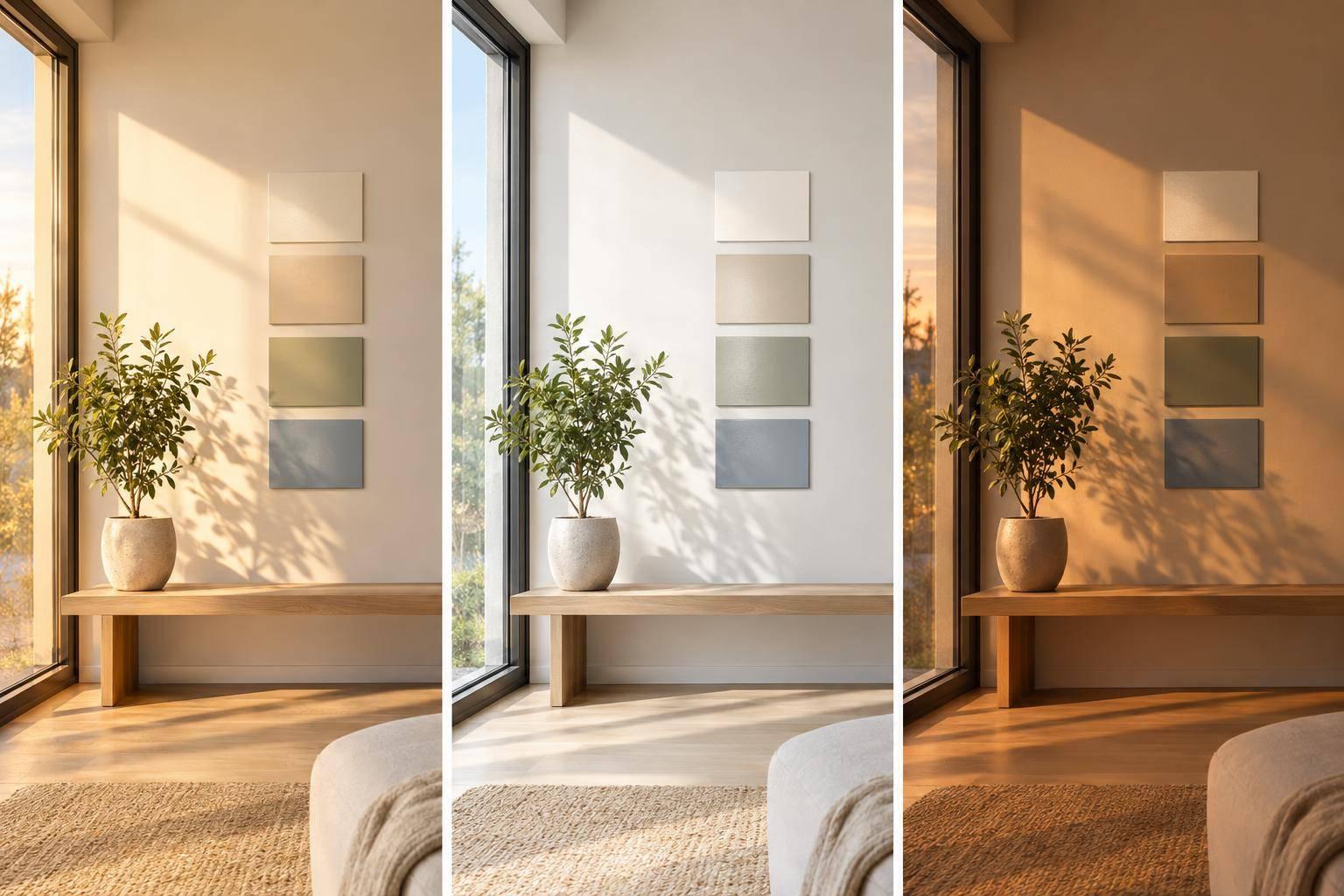
Choosing Paint Colors That Complement Your Home's Natural Light
I choose paint by testing it in the room - not by trusting a color card. Start with two to four samples, and check them in morning, afternoon, and evening light, plus under your usual lamps.
Here’s what I check before choosing:
- Daylight: Window direction, shade, and outdoor reflections help me narrow down warm or cool undertones.
- Color and finish: I compare samples with flooring, cabinets, and trim, then check color depth, light reflection, and sheen.
- Room tests: I judge dried samples in sun and shade, especially when I use the room most.
- Paint prep: I confirm the color and finish, check for repairs, and plan protection and cleanup. In homes built before 1978, I check for lead risks before disturbing old paint.
My rule: <u>let the room decide</u>. A paint color needs to work with your light, finishes, and daily routine.
Best paint colors for rooms with bad natural sunlight!
sbb-itb-b9ba8eb
Match Paint Undertones to Window Direction
Use your daylight notes to find undertones that suit the room. Window direction can make the same paint look warmer, cooler, lighter, darker, or more muted. Use the table to narrow your samples - not pick the final color. Shade and colors reflected from outdoors can still change how paint looks.
| Window direction | Typical light quality | Likely color effects | Undertones to test |
|---|---|---|---|
| North | Cool, indirect, and relatively consistent | Colors may look darker, cooler, flatter, or more blue-gray | Warm beige, warm greige, creamy white, soft blush, or warm green |
| South | Brighter and warmer, often with stronger sunlight | Colors may look lighter, warmer, more saturated, or washed out | Neutral shades, cool white, muted blue, soft sage, or cool gray-green |
| East | Warm and bright in the morning, cooler and dimmer later | Colors can shift noticeably between morning and afternoon | Neutral shades, warm-leaning white, soft green, or muted greige |
| West | Softer or cooler in the morning, warmer and more golden later | Red, orange, yellow, or warm beige undertones may intensify near sunset | Balanced or slightly cool white, muted blue, gray-green, or mild warm neutral |
Once you've narrowed your options, test those undertones in the room itself.
Choose Undertones for North and South Light
In north-facing rooms, start with warm whites, warm greiges, or soft blush tones before trying cooler grays. Test each sample on the wall under your usual lighting.
For south-facing rooms, try neutral shades or cool whites. Southern daylight can help cooler neutrals and muted midtones feel more balanced.
Morning and afternoon sun call for another check: the same sample can look different as daylight changes.
Plan for Changing East and West Light
In east-facing rooms, test paint when you use the room most often.
Check west-facing samples in late afternoon and near sunset, when warm undertones usually intensify. If you spend much of the day in the room, compare a balanced neutral with a warmer sample and a cooler one. Use the room in the evening? Check the samples under your usual lamps, too.
Choose Color Depth and Coordinate Finishes
Once you know how daylight behaves, compare paint colors with the finishes that will stay in the room.
Compare Undertones With Existing Finishes
Start with what’s staying. Place samples beside flooring, cabinetry, countertops, trim, and large furnishings in the room’s natural light. Side-by-side comparisons make undertone shifts easier to spot.
Use the largest fixed surface as your reference. Warm colors pair with warm materials, while cool colors pair with cooler finishes. If the room has both, look for a balanced neutral. Treat white trim as a fixed color, too: its undertone affects how the wall color looks. Then use LRV and sheen to narrow your choices.
Balance Light Reflection, Depth, and Saturation
Light Reflectance Value (LRV) measures how much light a color reflects on a scale from 0 to 100. Check the manufacturer’s LRV when comparing options, but don’t let that number make the decision. It doesn’t describe undertone or saturation, and lighter paint can’t replace missing daylight.
Deeper colors feel heavier on the wall. Saturation also affects how strong a color looks: a bright, intense shade can feel stronger than a muted shade with similar lightness. Muted colors are often easier to pair with wood, stone, and patterned furnishings.
Lower-sheen paint helps hide surface irregularities. Glossier finishes show more surface detail and reflect more light, so test the color in the sheen you plan to use before painting. Next, move to wall samples to see the color in place.
Test Paint Samples in Your Room
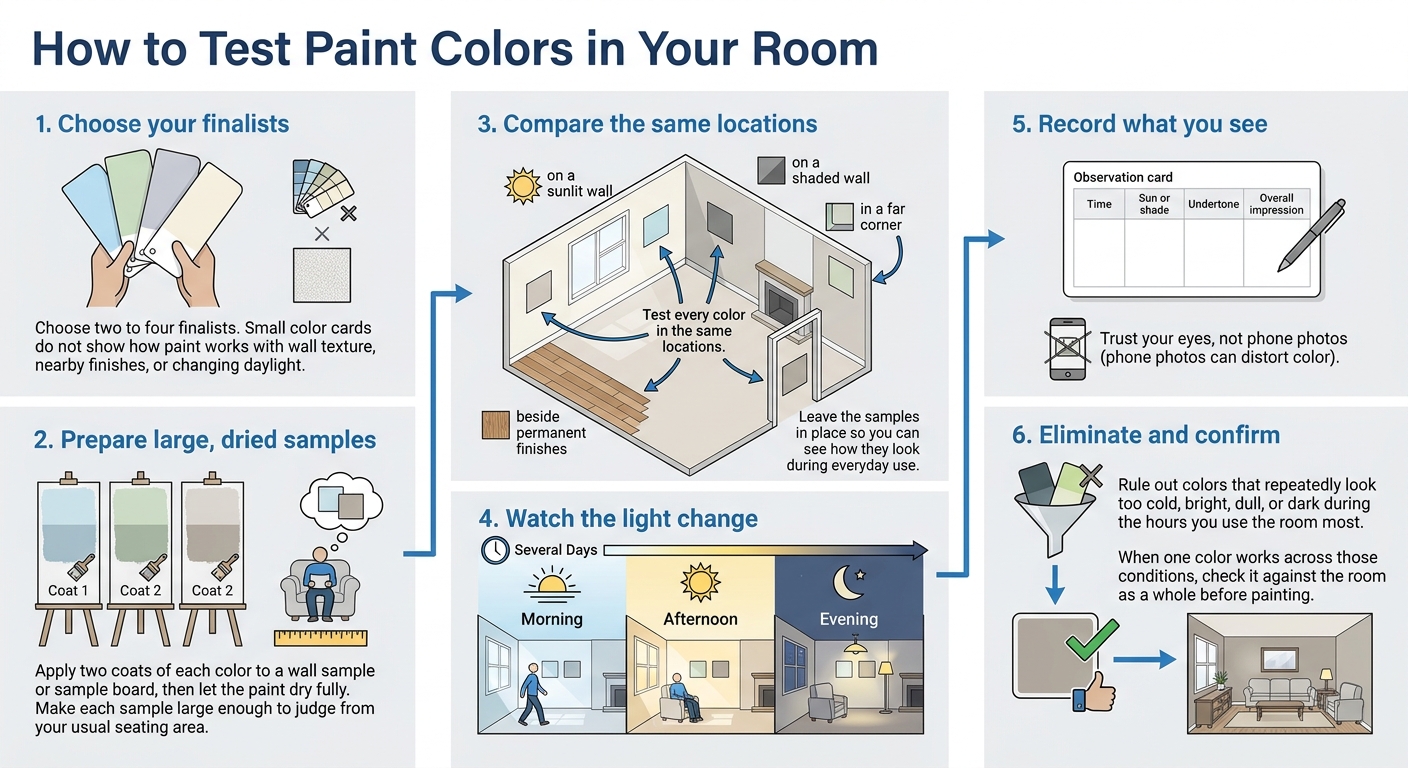
How to Test Paint Colors in Your Room
Let samples in your room guide the choice. Small color cards don’t show how paint works with wall texture, nearby finishes, or changing daylight. Test your finalists in the room’s strongest and weakest light to see how their undertones look.
Test Samples in Sun and Shade
Choose two to four finalists. Apply two coats of each color to a wall sample or sample board, then let the paint dry fully. Make each sample large enough to judge from your usual seating area.
Test every color in the same locations: on a sunlit wall, on a shaded wall, in a far corner, beside permanent finishes, and near doorways to adjoining rooms. Leave the samples in place so you can see how they look during everyday use.
Check Samples During Everyday Use
Keep samples up for several days. Check them in the morning, afternoon, and evening, including under your usual lamps and ceiling fixtures. View them from seating areas and walking paths. Trust your eyes, not phone photos, which can distort color.
Record the time, whether the sample is in sun or shade, its undertone, and your overall impression. Rule out colors that repeatedly look too cold, bright, dull, or dark during the hours you use the room most. When one color works across those conditions, check it against the room as a whole before painting.
Confirm Your Color and Prepare to Paint
Recheck Your Color and Inspect Surfaces
After several days of testing, take one more look at your chosen color beside flooring, cabinetry, trim, doors, and other fixed finishes. Check it from your usual viewing spots and through open sightlines into nearby rooms. Use the same morning, afternoon, and evening light you used when testing samples, and confirm that the sheen matches your planned finish.
Next, inspect walls, ceilings, trim, and doors for dirt, grease, dust, peeling paint, cracks, nail pops, drywall damage, water stains, mildew, holes, and uneven texture.
Clean surfaces as needed, remove loose paint, and repair defects. Let patches dry, sand them smooth, and remove the dust. Prime repaired or stained areas where needed before painting. Have recurring stains, moisture damage, or major unevenness evaluated rather than simply painting over them.
Homes built before 1978 may contain lead-based paint. If lead may be present, use lead-safe procedures before prep begins.
Plan Your Home Painting Project
Before buying materials or approving the work, record the color name, product line, sheen, and rooms to be painted.
Confirm the repairs, furniture protection, cleanup, and order of work before the project starts. Identify which rooms need to stay usable, and arrange safe spaces for children and pets.
FAQs
How do I choose paint for rooms with windows facing different directions?
Test paint samples directly on the wall in each room instead of relying on paint chips. Check them in the morning, at midday, and in the late afternoon to see how the color shifts as natural light changes.
In north-facing rooms or those without direct afternoon sun, pure white can look gray or blue. Try a warm off-white or soft greige to help the room feel bright and inviting.
Can nearby trees change how my wall color looks?
Yes, nearby trees and landscaping can change how your exterior wall color looks. Light and reflections from trees, shrubs, and lawns can affect the color you see and bring out different undertones.
Apply large paint samples directly to your wall and check them at different times of day. Seeing the samples next to your landscaping gives you a better sense of these effects than a paint card.
Should adjoining rooms use the same paint color?
Adjoining rooms don’t need the same paint color. Choose colors together, rather than room by room, to give your home a balanced, connected feel. A coordinated palette ties the house together while letting each room have its own color.
More guides
- Fence Painting and Staining: Complete Guide for San Gabriel Valley Homeowners
- Garage Makeover: Painting Walls, Floors, and Cabinets for a Complete Transformation
- 5 Signs Your Home Exterior Needs Repainting This Spring
- How Often Should You Repaint Your Home in Southern California?
- How to Choose the Right Interior Paint Finish for Every Room
Related painting services
If this article covers something you are planning, these pages go into what the work actually involves on a job.
- Interior painting for walls, ceilings, trim, and cabinets, including how we mask and protect a house you are still living in.
- Single family home painting for a whole house inside or out, from the first walkthrough to the final punch list.
- Apartment building painting for owners and property managers with occupied units and common areas that have to keep working.
- Painting in Pasadena and the rest of the San Gabriel Valley, with the local prep, permit, and historic district notes that apply there.